Subfloor Preparation: The Step Most Contractors Skip

Ronell Moore
Owner, 180 Degree Floors & Moore
The single biggest predictor of commercial flooring longevity is not the material selected—it is the condition of the subfloor beneath it. Yet subfloor preparation is consistently the most underestimated and under-budgeted phase of commercial flooring projects. Contractors who skip or shortcut this step create failures that surface months later and cost multiples of what proper prep would have cost upfront.
A properly prepared subfloor must meet four criteria: level, clean, dry, and structurally sound. Each of these has specific, measurable standards in commercial work. ASTM F710 establishes the benchmark: the subfloor must be flat within 3/16 inch over a 10-foot radius when measured with a straightedge. Variations beyond this tolerance cause visible imperfections in the finished floor, accelerate wear patterns, and create trip hazards in high-traffic areas.
Achieving F710 flatness on a typical commercial concrete slab almost always requires mechanical grinding. New construction slabs are poured to structural tolerances, not flooring tolerances—the concrete crew is building a building, not a flooring substrate. At 180 Degree Floors, we use HTC Superfloor diamond grinding equipment to bring slabs within specification, removing high spots and exposing a clean aggregate surface that accepts leveling compounds and adhesives properly.
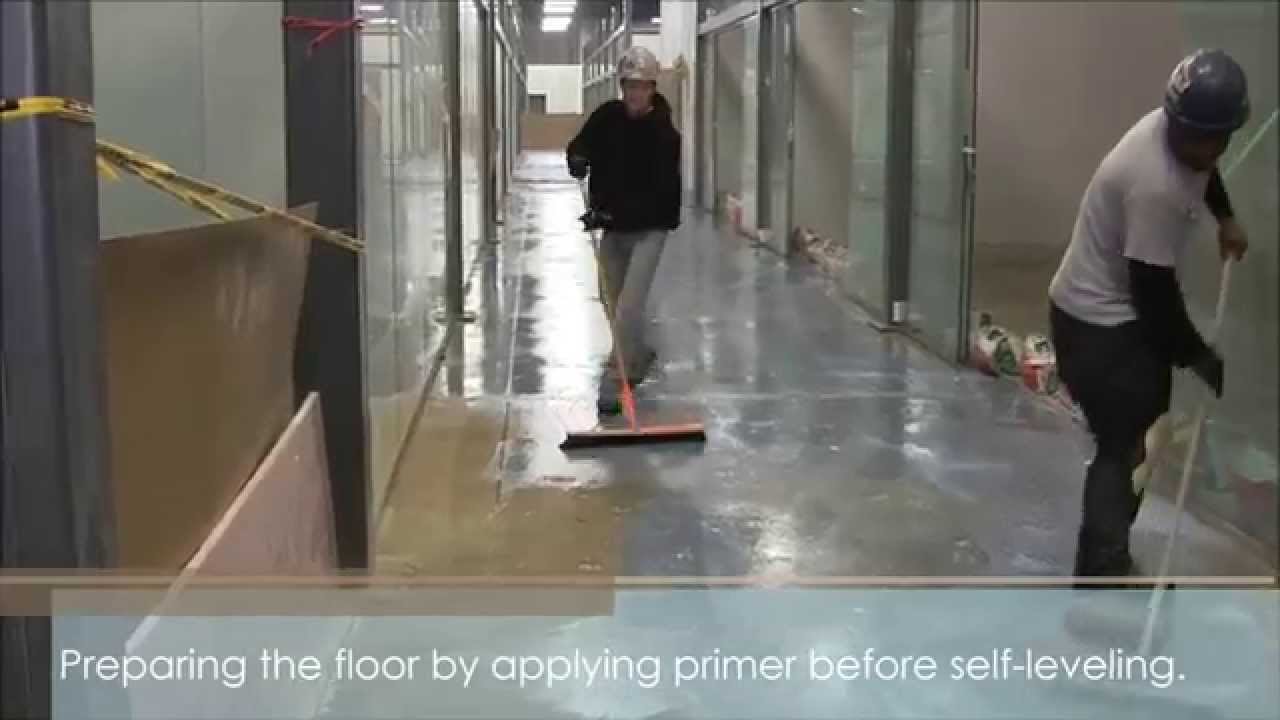
Self-leveling compounds fill low spots and create a uniform plane across the slab. Modern self-levelers like Ardex K-301 or Mapei Ultraplan Eco 20 Plus can be poured at thicknesses from feather-edge to 1 inch in a single lift, curing to foot traffic in 2 to 4 hours. The key is proper priming—the concrete surface must be primed with a compatible primer to prevent the leveler from drying too fast and losing bond strength.
Moisture testing is the most critical and most frequently skipped step in commercial subfloor preparation. Concrete slabs can retain moisture for months after construction, and the moisture does not always present visible symptoms. Elevated moisture levels cause adhesive failure, mold growth, and material degradation regardless of the flooring system installed above.
Two ASTM-standard tests measure concrete moisture. ASTM F2170 uses in-situ relative humidity probes drilled into the slab at 40% depth—the result is expressed as a percentage of relative humidity within the concrete. Most flooring manufacturers require readings below 75% RH for their warranty to apply. ASTM F1869 uses calcium chloride dishes placed on the slab surface, measuring moisture vapor emission rate (MVER) in pounds per 1,000 sq ft per 24 hours. The typical threshold is 3 lbs or less.
We perform both tests on every commercial project because they measure different things. F2170 tells you the moisture condition inside the slab. F1869 tells you the rate at which moisture is reaching the surface. A slab can pass one test and fail the other depending on slab age, ambient conditions, and whether a vapor barrier was installed below the concrete during construction.
When moisture readings exceed manufacturer thresholds, the options are: wait for the slab to dry (which can take months), apply a moisture mitigation system (epoxy-based barriers that seal the slab surface), or specify a flooring system that tolerates higher moisture. In most commercial timelines, waiting is not practical—so moisture mitigation becomes a necessary line item. Systems like Ardex MC Rapid or Mapei Planiseal VS can reduce MVER to below 3 lbs within 24 hours of application.
Crack repair is another preparation step that prevents future flooring failures. Concrete slabs develop cracks from shrinkage, structural settling, and thermal cycling. Cracks wider than 1/8 inch must be routed out, filled with semi-rigid epoxy, and blended flush with the slab surface. If cracks are structural (actively moving), they require a flexible fill that accommodates ongoing movement without telegraphing through the finished floor.
The economics of subfloor preparation are counterintuitive. Facility managers see it as an added cost that inflates the project budget. In reality, it is the most cost-effective phase of the entire project. A $2,000 investment in proper leveling and moisture mitigation on a 5,000 sq ft installation prevents the $15,000+ cost of tearing out and replacing a failed flooring system two years later. We have done tear-out work in Nashville where the failure was 100% attributable to skipped subfloor prep—it is the most expensive shortcut in commercial flooring.
When evaluating commercial flooring contractors, ask specifically about their subfloor preparation process. Ask what testing standards they follow, what equipment they use for grinding, and whether moisture mitigation is included in their scope or treated as an add-on. The answers will tell you whether they are building a system designed to last or simply laying material over existing problems.
At 180 Degree Floors, surface preparation is not a line item we negotiate away—it is the foundation of our substrate-to-surface approach. Every project begins with slab assessment, moisture testing, and a preparation scope that ensures the finished floor performs for its full expected lifecycle. That commitment is what separates us from contractors who compete on price alone.
Related Services
180 Degree Floors & Moore — Commercial Division
Schedule Site Walk